
Table of Contents
- What Is the Difference Between Travertine and Marble?
- Travertine vs Marble for Exterior Facades: Quick Comparison
- How Do Travertine and Marble Perform on External Facades in the UAE?
- Which Looks Better on a Building Facade: Travertine or Marble?
- Which Finishes Work Best for Exterior Travertine and Marble?
- What Should You Consider Before Choosing Travertine or Marble for a Facade?
- Does Installation Affect the Performance of a Natural Stone Facade?
- So, Is Travertine or Marble Better for an External Facade?
- Not Sure Whether Travertine or Marble Fits Your Project?
- Why Choose Al Asal Marbles for Travertine and Marble in the UAE?
- Let’s Transform Your Facade with the Right Natural Stone
- Frequently Asked Questions
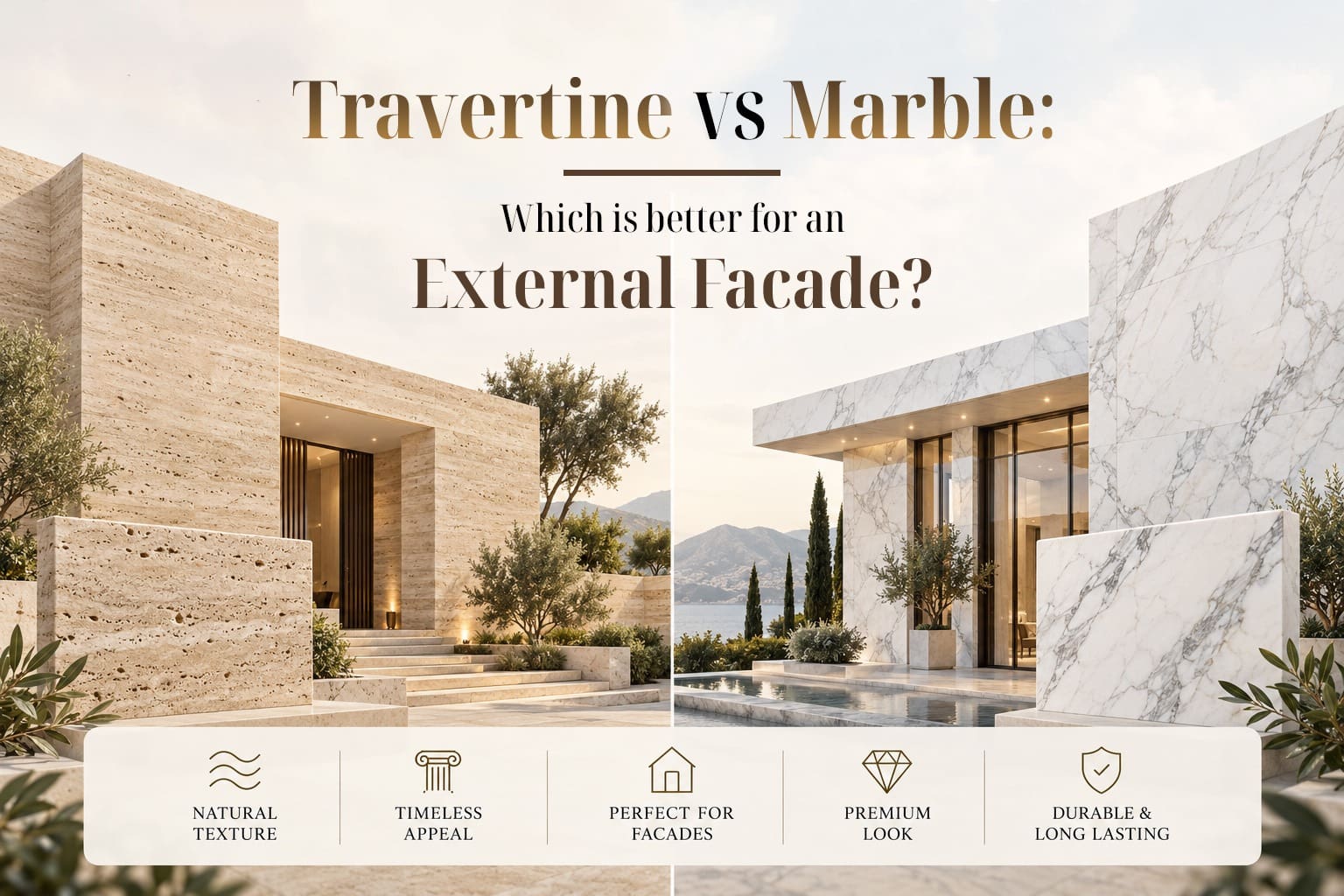
Are you looking for a suitable stone for an external facade in the UAE and wondering which option would win the travertine vs marble debate? In most cases, travertine works better on exterior walls simply because of how it behaves in heat, dust and direct sun, but the honest answer depends on the exact stone, finish and installation method you choose.
Marble can absolutely work on an external facade too, provided the variety and specification suit outdoor exposure. This guide breaks down how each stone performs on building exteriors in this region, so you can make a decision based on your project rather than a general rule.
What Is the Difference Between Travertine and Marble?
The stones form differently, and that difference matters most once they need to be used on the outside of a building. Travertine develops with natural gas pockets trapped inside it, while marble forms under heat and pressure that fuses its crystals into a tighter, denser structure. That single distinction shapes almost everything else on this list, from how each stone looks to how it wears over the years.
Travertine
A travertine facade typically shows small natural cavities across its surface, along with warm, earthy tones ranging from ivory to golden beige. This texture isn’t a flaw. It’s part of why architects have used travertine natural stone on exterior walls, courtyards and columns for centuries, and it tends to soften the look of large, sun-heavy elevations.
Marble
A marble facade carries a smoother, denser structure with the veining marble is known for, giving buildings a more polished, formal character. This makes marble a strong pick where the brief calls for a refined, statement-making exterior rather than a textured, organic one.
Neither structure is automatically “better” outdoors. A natural stone facade performs well when the stone’s properties are matched correctly to the building’s exposure and design intent.
Travertine vs Marble for Exterior Facades: Quick Comparison
Before choosing between the two, it helps to see how they typically compare on the factors that matter most for exterior stone cladding projects.
| Factor | Travertine | Marble |
| Exterior suitability | Well suited when finished and installed correctly | Suitable with the right variety, finish and thickness |
| Heat & sunlight | Handles heat well due to its structure | Performs well too, though heat and glare can affect colour and finish over a long period (years) |
| Porosity | Higher, needs sealing and maintenance | Lower to moderate, varies by stone type |
| Appearance | Warm, textured, natural movement | Refined, huge variety, more formal |
| Common finishes | Honed, brushed, polished, filled or unfilled | Honed, leather, polished etc |
| Maintenance | Depends on usage | Sealing and periodic cleaning, depending on porosity |
| Best suited for | Interior walls, boundary walls, external or textured claddings, bathrooms | Entrances, lobbies, statement elevations/walls, floors, vanities, bathrooms, step & risers, tables and other flat surfaces |
This is a general guide rather than a fixed rule, since individual slabs and finishes within either category can behave quite differently.
How Do Travertine and Marble Perform on External Facades in the UAE?
The UAE climate is the real test for any exterior stone, and it’s where generic international comparisons often fall short.
Heat and Direct Sunlight
High temperatures and long hours of direct sun affect every stone on a facade, and the finish plays a big role in how that heat is absorbed and reflected. On a villa facade or any building facade with a west-facing elevation, both stones can handle heat well. But the colour and finish of marble might deteriorate over a long period of time.
Dust, Moisture and Weather Exposure
Airborne dust and occasional rain interact with a stone’s surface differently depending on how porous it is. Stone sealing helps reduce how much dust and moisture penetrate the surface, though it needs to be reapplied over time rather than treated as a one-off step.
Long-Term Durability
Durability on an exterior wall isn’t purely about whether the material is travertine or marble. Slab thickness, quarry quality, finish and how well the installation team specified the stone all influence how it ages.
Which Looks Better on a Building Facade: Travertine or Marble?
It genuinely depends on the architectural style you’re working with, not on one stone being objectively more attractive.
For Warm, Natural Facades
Travertine works well for a warm and natural look. It also adds a Mediterranean aesthetic to external facades. But marble also works for this purpose. Shades like ivory, cream and the honey tones of crema uno marble give facades a warm, grounded feel with natural texture and movement. This suits villas, boutique hotels and buildings that lean into a softer, earthier aesthetic rather than a sharp, formal one.
For Refined, Statement Facades
Dark marble varieties bring a more luxurious, formal presence to a building’s exterior. A commercial facade aiming for a striking entrance or lobby frontage often leans towards these varieties.
Many people have a fascination towards white marble. But the problem is that white marble on external facades might turn light pale yellow after many years in the sun. So, it’s better to choose white marble and other varieties, such as calacatta marble and statuario marble for internal applications, like lobbies. Sometimes these marbles are used in internal spaces alongside quartz for added consistency in colour and pattern.
For a deeper look at stone types, check out our blog Marbles: A Comprehensive Guide.
Which Finishes Work Best for Exterior Travertine and Marble?
Finish selection can change how suitable a stone is for exterior use just as much as the stone type itself.
Travertine Finishes
- Honed finishes give a smooth, matte surface that suits most exterior applications and hides dust build up reasonably well.
- Brushed finishes add texture and grip, which works well for ground-level walls and boundary features. But this finish can be tricky to do due to the natural gaps in the stone. It is also rare as people prefer to keep the natural look that adds a lot of character to a place.
- Filled travertine has its natural holes closed with resin or grout (transparent or coloured), while unfilled travertine keeps its open, textured look, and the choice affects both surface finish and maintenance needs.
- Polished travertine is also another popular finish. It brings a rich and luxurious look.
Marble Finishes
Polished marble isn’t the only option for exteriors, and in fact honed or leather finishes are often more practical for facades because they reduce glare and are less prone to showing scratches from dust and wind-blown grit. The right finish should be chosen based on the elevation’s sun exposure and how much upkeep the project can realistically commit to, not on appearance alone.
What Should You Consider Before Choosing Travertine or Marble for a Facade?
Moving from “which stone looks right” to “what should actually be specified” is where most successful facade projects are decided. Before finalising a choice, it helps to run through the following:
- Direct sun exposure hours on the specific wall or panel in question.
- Stone variety and its inherent physical properties, including hardness and grain structure.
- Slab or panel thickness suited to the height and wind load of the facade.
- Surface finish appropriate to the exposure and desired look.
- Natural colour variation expected across the full order, not just the sample piece.
- Sealing requirements and how often they’ll need repeating.
- Fixing and installation system suited to the panel size and building type.
Does Installation Affect the Performance of a Natural Stone Facade?
Yes, and this is often overlooked in comparisons that focus purely on the stone itself. Even a genuinely suitable stone can underperform on a facade if it’s cut too thin, poorly fixed or left without proper sealing.
Stone Thickness & Selection
Panels that are too thin for their height or wind exposure are more prone to cracking or bowing over time, regardless of whether they’re travertine or marble.
Fixing & Installation
A reliable fixing system needs to be matched to the panel weight and building height. It keeps the cladding secure and reduces stress on the stone itself.
Sealing & Maintenance
Sealing needs to be reapplied on a schedule rather than assumed to last indefinitely. Routine cleaning helps prevent dust and grime from settling into the surface.
So, Is Travertine or Marble Better for an External Facade?
Travertine is generally the more practical choice when a project calls for a warm, natural-looking exterior material with a long, proven history in facade and outdoor architecture, and this established use is echoed across specialist stone sources. Marble can also work well on external facades, but the right variety, finish, thickness and installation method matter far more here than they would indoors. Ultimately, the decision should rest on the specific building, its exposure and its long-term performance needs, not on the material name alone.
Not Sure Whether Travertine or Marble Fits Your Project?
Explore Al Asal Marbles’ natural stone collection and compare suitable options for your villa, commercial building or architectural facade.
Why Choose Al Asal Marbles for Travertine and Marble in the UAE?
Choosing between travertine and marble is easier with the right guidance and a proper look at the actual stone, not just a catalogue image. At Al Asal Marbles, we help clients select from a wide range of colours and finishes across both categories, matched to the specific application, whether that’s a villa entrance, a boundary wall or a full commercial elevation.
As one of the top marble companies in the UAE, we work with residential and commercial projects across the region and offer honest, application-based advice rather than a one-size-fits-all recommendation. Visit our showroom to see the stone in person, or get in touch with our team for material selection guidance suited to your project. Check out our website or contact us now to understand what makes us a trusted natural stone supplier in the UAE.
Let’s Transform Your Facade with the Right Natural Stone
Visit Al Asal Marbles to view available materials and get practical guidance on stone selection, finishes and project requirements.